
When manufactured electronic assemblies fail weeks or months after delivery rather than during initial testing, the cause often lies in an invisible threat present during production. A technician handles a printed circuit board without proper earthing, a component rests briefly on a standard plastic surface, or a populated PCB travels between workstations in conventional packaging. No sparks fly, no alarms sound, yet damage accumulates silently within sensitive integrated circuits, only to manifest as field failures that erode client confidence and inflate warranty costs.Electrostatic discharge represents one of the most consistently underestimated risks in electronics manufacturing precisely because its most damaging effects remain imperceptible until well after the moment of occurrence. Understanding how ESD damages components, identifying the sources active in production environments, and implementing proportionate protection measures can transform unexplained failure rates into predictable quality outcomes.
What is ESD and how does it damage electronics?
Electrostatic discharge describes the sudden transfer of electrical charge between two objects at different electrical potentials. The phenomenon itself is commonplace—the small spark felt when touching a metal door handle after walking across carpeting demonstrates ESD in everyday life. In electronics manufacturing contexts, however, this same physical process occurs at voltage levels far below human perception, yet sufficient to compromise semiconductor junctions and thin oxide layers within modern components.
According to BSI’s BS EN IEC 61340-5-1:2024, the standard defining ESD control programme requirements in the UK and Europe, electronic components susceptible to damage by electrostatic discharges of 100 volts Human Body Model (HBM), 200 volts Charged Device Model (CDM), or 35 volts on isolated conductors fall within the scope requiring systematic protection. Many modern integrated circuits exhibit sensitivity thresholds even lower than these baseline figures, with certain advanced components damaged by discharges as modest as 10 to 25 volts.
100V
HBM threshold
Many modern electronic components can be damaged by electrostatic discharges of just 100 volts or less, whilst common workshop activities can generate charges several orders of magnitude higher—creating a substantial risk gap.
This disparity between generation levels and damage thresholds creates the central challenge. Routine activities in uncontrolled environments—walking across vinyl flooring, handling plastic containers, removing synthetic garments—can generate electrostatic charges measuring in the thousands of volts. The specific values vary considerably based on humidity levels, material properties and movement speed, but the fundamental mismatch persists: actions that feel entirely normal to personnel produce electrical potentials capable of damaging components rated for far lower voltage exposure.
Human perception compounds the invisibility problem. People typically sense electrostatic discharges only when they exceed approximately 3,000 volts—the threshold at which the small spark becomes perceptible as a slight shock. Discharges occurring at 100 volts, 500 volts, or even 1,000 volts pass entirely unnoticed by the person handling the component, despite inflicting damage to semiconductor devices sensitive to such levels.
Catastrophic failures represent the minority of ESD damage events. These occur when the discharge energy completely destroys a junction or connection, causing immediate and total component failure detectable during production testing. Whilst dramatic, catastrophic failures actually serve quality control by preventing defective assemblies from reaching customers.
Latent damage risk: The majority of ESD events cause latent damage rather than immediate catastrophic failure. Components function normally during initial testing but have suffered cumulative degradation that manifests as field failures weeks or months after handling, making root cause identification particularly difficult.
Latent damage presents the more insidious threat. A discharge weakens an oxide layer without breaching it entirely, partially degrades a bond wire connection, or stresses a junction below its immediate failure threshold. The component passes all production testing because it remains functional at that moment. Only after extended operational stress—thermal cycling, voltage variations, mechanical vibration during transport and installation—does the weakened structure fail. By this point, the assembly sits installed in a customer’s system, the failure appears as an inexplicable field defect, and the true cause remains obscured by the temporal and physical distance from the damaging event.
This explains why production facilities often experience rising field failure rates without corresponding increases in production test failures. A technician manipulates a PCB populated with automotive engine control unit components without proper earthing, causing latent damage to several integrated circuits. Initial functional testing reveals no issues. Three months after installation in vehicles, engine management faults begin appearing across the affected batch, prompting costly recalls and damaging the manufacturer’s reputation with their automotive client—consequences far exceeding the modest investment required for appropriate ESD protection during assembly.
Common sources of ESD in professional environments
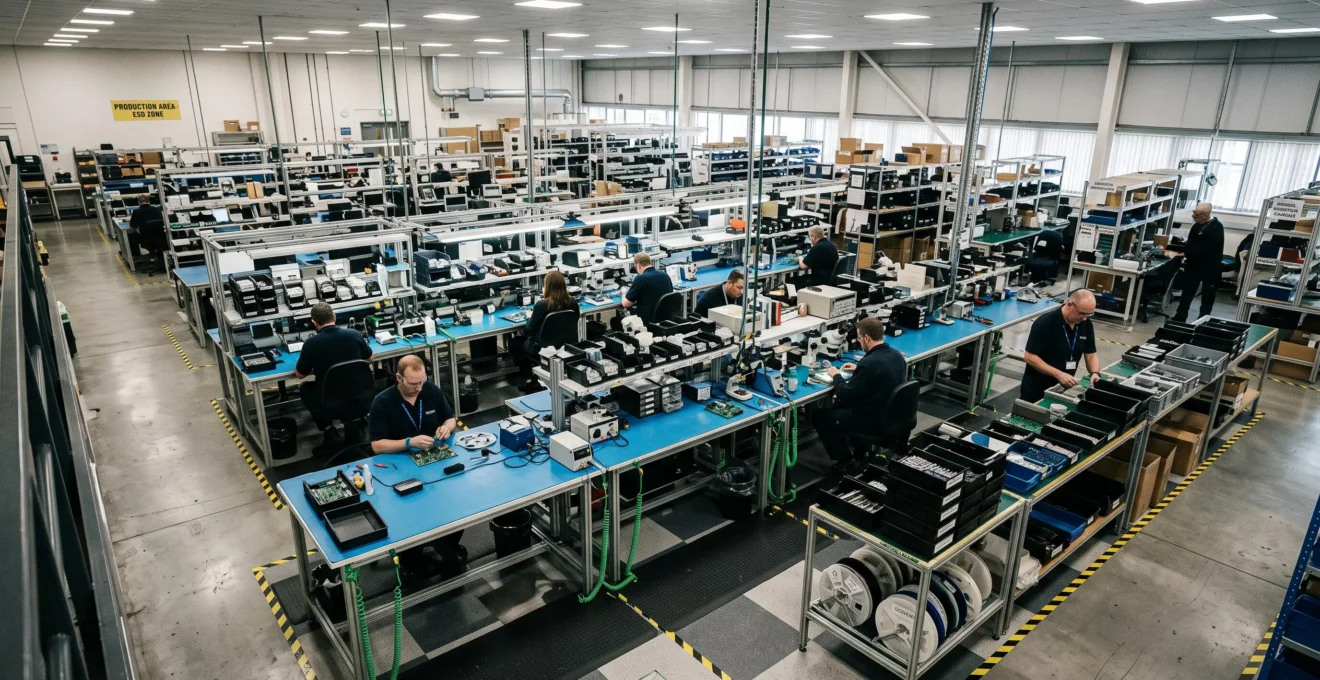
Identifying ESD sources within existing production environments allows prioritisation of control measures according to actual risk levels rather than theoretical possibilities. Most facilities contain multiple charge generation mechanisms operating simultaneously, though certain sources dominate the threat profile.
The human body functions as the primary ESD source in electronics assembly environments. Personnel accumulate electrostatic charge through friction between clothing and work chairs, footwear and floor surfaces, or garments and skin during normal movement. Without a controlled discharge path to earth, this accumulated charge transfers suddenly to conductive objects upon contact—including component leads, PCB traces, and connector pins. The absence of proper personnel earthing represents the single most significant ESD risk factor in production facilities.
Work surfaces and materials constitute the second major source category. Standard laminate workbenches, plastic component trays, vinyl floor covering, foam packaging materials, and conventional office chairs all exhibit insulating properties that allow charge accumulation. When charged components or assemblies contact these surfaces, or when these materials contact grounded objects, discharge events occur. Production environments designed without ESD considerations typically contain numerous such sources distributed throughout the facility.
The EOS/ESD Association notes that environmental factors significantly influence charge generation rates. Low relative humidity—particularly common in UK facilities during winter months when heating systems reduce ambient moisture—increases charge generation and accumulation. Air forced heating and air conditioning both tend to reduce humidity levels, explaining why some facilities experience seasonal variations in ESD-related defect rates even when handling procedures remain constant.
Unprotected equipment and tools introduce additional charge sources. Standard screwdrivers, pliers, and assembly tools made from insulating plastics generate charge during use. Metal transport trolleys without earthing connections can accumulate and discharge voltages. Even test instruments and production machinery lacking proper ESD protection contribute to the threat environment when they contact sensitive assemblies.
- Personnel earthing systemsVerify whether technicians handling sensitive components wear wrist straps or ESD footwear connected to verified earth points, or work without any personnel grounding.
- Work surface materialsIdentify workbench surface types—standard laminate, untreated wood, and plastic surfaces all function as charge generators requiring replacement with dissipative alternatives.
- Flooring characteristicsNote floor covering materials throughout assembly areas, particularly vinyl, carpet, or sealed concrete which promote charge generation when personnel walk across them.
- Component packaging and storageExamine containers and packaging materials in use—standard plastic bags, foam, and bins allow charge accumulation unlike purpose-designed ESD-safe packaging.
- Environmental humidity levelsMeasure relative humidity in production areas, especially during winter heating periods when levels frequently drop below the 30-40% range where charge generation accelerates markedly.
In typical UK electronics assembly facilities, the combination of standard vinyl or carpet flooring, conventional work furniture, and absence of personnel earthing creates an environment where charge generation occurs continuously throughout the working day. Without intervention, each component manipulation represents a potential ESD event.
Which industries and components need ESD protection most?
ESD protection requirements vary considerably across industries and component types. Understanding where specific production operations sit within this risk landscape helps justify investment levels and establish appropriate control measures relative to actual vulnerability and contractual obligations.
Critical-risk sectors face both technical vulnerability and contractual enforcement of ESD standards. Automotive electronics manufacturing handles engine control units, advanced driver assistance systems, and safety-critical components where field failures carry severe consequences. Medical device assembly involves patient monitoring equipment, implantable devices, and diagnostic instruments where reliability directly affects clinical outcomes. Aerospace applications demand exceptional reliability for avionics, navigation systems, and control electronics. Facilities serving these sectors typically face ESD protection requirements written directly into customer contracts, with compliance to standards such as IEC 61340-5-1 verified through regular audits.
The ANSI/ESD S20.20-2021 standard, recognised internationally and applied alongside the equivalent IEC standard, establishes that ESD control programmes apply to items susceptible to damage by discharges of 100 volts HBM and 200 volts CDM. This threshold encompasses the vast majority of modern semiconductor devices, placing most electronics manufacturing within the scope requiring systematic protection.
Component sensitivity classification follows the Human Body Model (HBM) testing methodology, which simulates the discharge that occurs when a charged person touches a grounded component. The classification system groups components into sensitivity classes:
| HBM Class | Voltage threshold | Typical components | Primary industries |
|---|---|---|---|
| Class 0 | <25V | Advanced processors, modern CMOS | Medical devices, aerospace |
| Class 1A | 25-250V | Standard integrated circuits, memory | Automotive, telecommunications |
| Class 1B | 250-500V | Small-scale integrated circuits | Consumer electronics, computing |
| Class 2 | 500-2000V | Older semiconductor devices | Industrial controls, legacy systems |
| Class 3 | >2000V | Robust discrete components | Power electronics, basic assemblies |
The ongoing trend towards semiconductor miniaturisation continuously increases ESD vulnerability. Modern integrated circuits manufactured using 10-nanometre process nodes and below typically fall into Class 0 or Class 1A, exhibiting damage thresholds below 250 volts. Facilities that historically assembled electronics using older, more robust components (Class 2-3) now find themselves handling significantly more sensitive devices as their product specifications evolve, necessitating re-evaluation of protection measures that may have seemed adequate for previous component generations.
Manufacturing printed circuit boards for automotive or medical applications—as in the case of a Manchester-based facility producing ECU assemblies—clearly sits within the critical-risk category. Components rated Class 0 to Class 1A dominate modern automotive electronics, whilst customer quality standards explicitly require demonstrable EPA compliance and typically mandate adherence to ISO standards that reference ESD control as a requirement. The unexplained field failures appearing months after production strongly suggest latent ESD damage as a root cause, particularly when production test failures remain stable whilst post-delivery defects increase.
Moderate-sensitivity sectors including consumer electronics, standard telecommunications equipment, and general computing assemblies still benefit substantially from ESD protection, though contractual requirements may be less stringent. Even here, the prevalence of Class 1A and 1B components means that uncontrolled environments create meaningful risk of latent damage affecting product reliability and warranty costs.
Essential ESD protection equipment and solutions
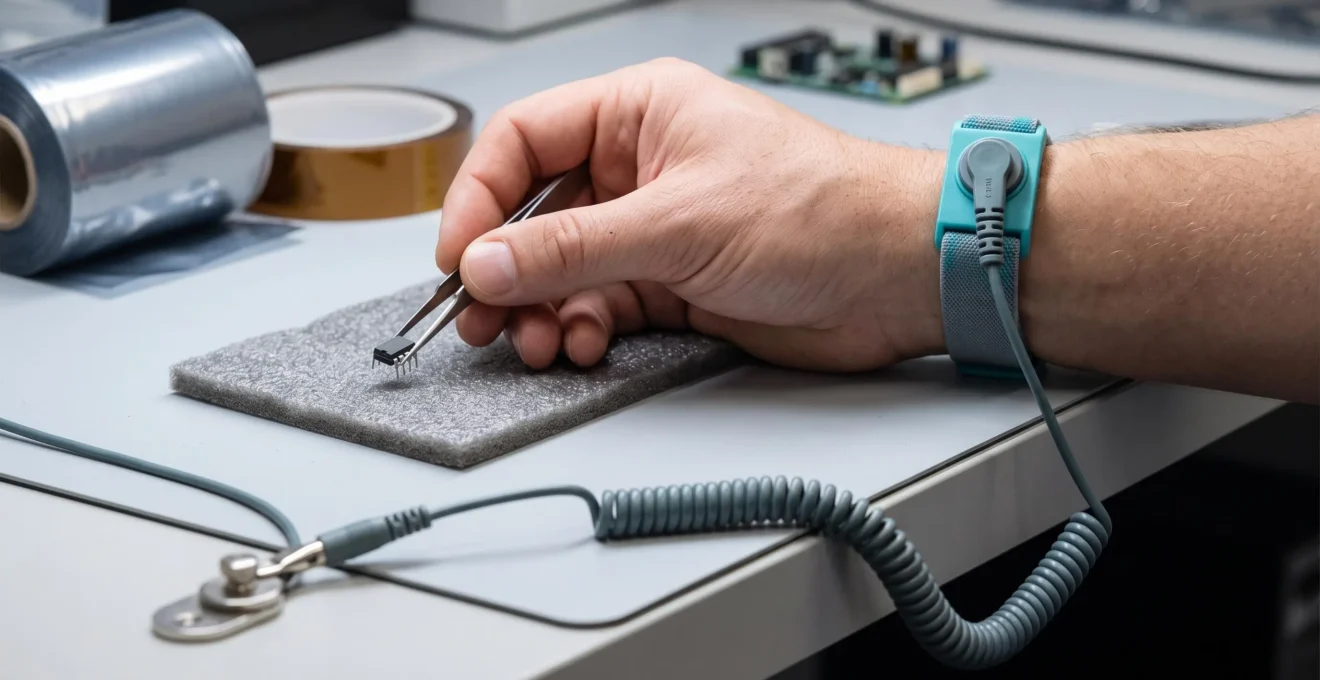
Effective ESD control requires coordinated equipment addressing the primary charge sources identified earlier. The protection hierarchy moves from essential personnel earthing through packaging and storage solutions to comprehensive environmental controls, allowing staged implementation matched to budget constraints and compliance requirements.
Personnel grounding equipment represents the first priority because the human body constitutes the dominant ESD source in assembly environments. Wrist straps consist of a conductive band worn on the operator’s wrist, connected via a current-limiting resistor (typically 1 megohm for safety) and coiled cord to a verified earth point. When properly connected and tested, wrist straps continuously drain accumulated body charge to earth, preventing discharge during component handling. Alternatively, ESD footwear or heel grounders combined with conductive flooring provide earthing during movement, though wrist straps offer more reliable protection at seated workstations. This basic level of personnel protection—wrist straps for all technicians handling sensitive components, combined with daily continuity testing—represents the minimum viable protection for electronics assembly.
ESD-safe packaging and storage protects components before, between, and after direct handling. Metallised shielding bags provide a Faraday cage effect, preventing external electrostatic fields from reaching enclosed components whilst safely dissipating any internal charges. Conductive plastic containers, foam inserts with controlled resistivity, and component reels designed for ESD environments maintain protection during storage and inter-workstation transport. Standard plastic bags, conventional foam, and untreated cardboard boxes lack these properties and should be eliminated from areas handling sensitive devices.
Critical distinction—Antistatic vs ESD-safe: Materials labelled ‘antistatic’ reduce charge generation through resistivity in the range of 109 to 1012 ohms but do not provide controlled charge dissipation. ‘ESD-safe’ or ‘static dissipative’ materials exhibit resistivity between 104 and 1011 ohms, allowing controlled charge dissipation whilst preventing rapid discharge. Only ESD-safe materials meet EPA compliance standards under IEC 61340-5-1. Purchasing antistatic equipment believing it provides ESD protection represents a common and costly specification error.
Electrostatic Protected Area (EPA) configuration extends protection to the complete workstation environment. Static-dissipative work surfaces (typically vinyl or rubber mats with resistivity of 106 to 109 ohms) bonded to earth provide a controlled surface for component placement and assembly work. ESD flooring—either dissipative tile, painted coatings, or grounded mats—eliminates charge generation from foot traffic. Conductive or dissipative chairs prevent charge accumulation during seated work. Air ionisers neutralise charges on insulating materials that cannot be grounded directly, such as component packaging materials necessarily present in the work area. A properly configured EPA ensures that all conductive and dissipative items within the protected zone connect to a common earth point, typically verified at less than 1 megohm resistance.
Verification and monitoring instrumentation transforms ESD protection from an assumed condition to a verified state. Wrist strap testers allow daily verification of proper earthing before work commences—a critical practice given that wrist strap failures through cord damage or poor skin contact represent common protection breakdowns. Surface resistance metres verify that work mats, flooring, and other materials maintain their specified resistivity over time. Continuous monitoring systems for EPA zones provide ongoing verification that earthing integrity remains intact throughout production. For facilities requiring compliance documentation for customer audits, this instrumentation provides objective evidence that controls function as intended rather than relying solely on procedural claims.
Understanding these equipment categories allows construction of graduated protection approaches. A minimal protection programme might comprise wrist straps, basic ESD-safe packaging, and desk-top work mats for critical assembly positions, representing an initial investment of perhaps £500 to £800 for a small team. An intermediate approach extending to partial EPA compliance for primary assembly areas with appropriate flooring, furniture, and verification instruments might range from £3,000 to £6,000 depending on facility size. Full EPA compliance across all production areas handling sensitive components, including continuous monitoring and comprehensive documentation systems, typically represents the £8,000 to £15,000 investment range for a facility of 10-15 workstations—falling within the budget envelope available to a production manager facing quality issues and an impending customer audit.
Implementing and choosing the right ESD protection
Deploying ESD protection effectively requires methodical progression from risk assessment through equipment installation to ongoing verification and personnel training. Attempting immediate full compliance without preparatory steps typically results in incomplete implementation, whilst indefinite delay pending perfect conditions allows preventable damage to continue.
The staged deployment approach balances urgency against resource constraints:
- Initial risk audit (Week 1)Identify component sensitivity classes currently handled, document existing charge sources in the facility, and determine contractual compliance requirements from customer specifications.
- Minimal viable protection (Weeks 1-2)Procure and deploy wrist straps with daily testers, acquire ESD-safe packaging for vulnerable components, and implement basic handling procedures for personnel in direct component contact.
- Critical zone protection (Weeks 3-6)Establish EPA-compliant workstations at positions performing final assembly and testing of populated boards, including dissipative work surfaces, appropriate seating, and verified earthing infrastructure.
- Extended EPA and monitoring (Weeks 7-10)Expand protected areas to cover component preparation and sub-assembly positions, install flooring solutions where justified by traffic patterns, and implement verification instrumentation for ongoing compliance documentation.
- Documentation and certification (Weeks 11-12)Develop written procedures, complete staff training with records, establish verification schedules, and prepare documentation packages for customer audits demonstrating IEC 61340-5-1 compliance.
This timeline demonstrates that meaningful protection begins within days rather than months, whilst full compliance suitable for formal audit verification remains achievable within a three-month horizon—directly addressing the constraint faced by a facility with a customer audit scheduled in that timeframe.
Selection criteria for appropriate protection levels should weigh multiple factors rather than defaulting to either minimal or maximal approaches. Component sensitivity drives baseline requirements—facilities handling Class 0 or Class 1A devices require more comprehensive protection than those working primarily with Class 2-3 components. Contractual obligations often establish non-negotiable minimums, particularly in automotive, medical, and aerospace supply chains where customers mandate EPA compliance and audit verification. Production volume and value influence the return on investment calculation; higher-volume operations or those producing high-value assemblies justify more comprehensive protection because the cost of field failures scales with production quantities. Budget availability affects implementation pace and breadth, though even constrained budgets can achieve meaningful risk reduction through prioritised deployment to critical positions.
Personnel training represents an indispensable component regardless of equipment investment level. Wrist straps provide no protection if not worn correctly or tested daily. ESD-safe packaging fails its purpose if personnel place components on standard plastic surfaces during handling. Work surface earthing connections must be verified as actually connected rather than assumed functional. A concentrated training session of two to three hours covering ESD fundamentals, proper equipment use, daily verification procedures, and recognition of non-compliant materials and practices provides sufficient foundation for production technicians. This investment addresses the concern that experienced staff might resist procedural changes—understanding why specific practices matter typically overcomes resistance born of ignorance about invisible risks. The connection to prevention of work accident risks extends beyond physical safety to encompass quality and reliability outcomes that affect business sustainability.
Some facilities explore sustainable equipment options as a means of controlling costs whilst meeting environmental responsibility objectives. Reconditioned ESD work surfaces, refurbished ionisers, and previously-used storage racks can reduce equipment costs by 30-40% compared to new purchases whilst providing equivalent protective functionality. This approach particularly suits initial deployments where budget constraints otherwise limit protection scope, allowing broader initial coverage that can be upgraded to new equipment as operational returns justify the investment. Ensuring that work uniforms for professionals include ESD-safe variants when handling sensitive assemblies complements facility-level controls with appropriate personal protective equipment.
- Audit component datasheets to identify HBM sensitivity classifications for all devices currently handled in production
- Order minimal personal grounding equipment (wrist straps, testers, basic ESD-safe packaging) for immediate deployment to critical assembly positions
- Map production floor to identify highest-risk zones where final assembly and testing of populated boards occurs
- Schedule concentrated 2-3 hour training session covering ESD risks, proper equipment use, and daily verification procedures
- Develop phased EPA deployment timeline aligned with budget availability and customer audit schedule
- Establish weekly verification routine for wrist strap continuity and work surface earthing integrity
- Document all procedures, training records, and verification results to build audit-ready compliance evidence
The return on investment for ESD protection becomes evident when comparing programme costs to the financial impact of field failures. A facility experiencing a shift from 2% to 5% defect rates on quarterly production of several thousand assemblies faces warranty replacement costs, engineering investigation expenses, expedited shipping charges, and potential customer penalties that rapidly exceed £15,000 per quarter. If 60-70% of these failures trace to latent ESD damage—a conservative estimate given the symptom pattern of delayed failures on components passing production testing—then even a £10,000 investment in comprehensive EPA protection achieves payback within two to three quarters purely through reduced failure costs, without accounting for protected customer relationships and avoided audit failures.
Building compliance documentation
Customer audits for automotive and medical electronics supply chains verify not merely that equipment exists but that procedures ensure its effective use. Documentation requirements typically include written ESD control plans describing protected areas and handling procedures, personnel training records demonstrating that all staff understand requirements, equipment verification logs showing regular testing of wrist straps and work surfaces, and corrective action records demonstrating response to any identified failures. Beginning documentation practices simultaneously with equipment deployment—rather than attempting retrospective record creation before an audit—ensures authentic compliance evidence.
The standards framework supporting this documentation centres on IEC 61340-5-1 for European and UK contexts, with ANSI/ESD S20.20 recognised as an equivalent standard internationally. Both establish requirements for EPA design, verification methods, and ongoing monitoring that provide objective criteria for compliance. Facilities supplying automotive customers typically face additional ISO/TS 16949 or IATF 16949 requirements that incorporate ESD control as an element of process control. Medical device manufacturers operate under ISO 13485, which similarly references electrostatic protection as a contamination and damage control requirement. Understanding which specific standards apply to particular customer relationships allows tailoring of documentation to expected audit frameworks.
Taking control of invisible failures
Electrostatic discharge persists as a quality threat precisely because it operates below the threshold of human perception whilst modern component sensitivity has decreased to levels making damage nearly inevitable in unprotected environments. The voltage mismatch between common charge generation activities and semiconductor damage thresholds—a gap measuring in orders of magnitude—creates risk that seems disproportionate until quantified against actual component specifications.
For production managers confronting unexplained field failures appearing weeks or months after assembly, latent ESD damage represents a probable root cause worthy of systematic investigation and targeted intervention. The characteristic pattern—assemblies passing production testing but failing during customer operation, with defect rates rising without corresponding changes in production test failures—aligns closely with the cumulative degradation mechanism of sub-threshold electrostatic stress.
Addressing this invisible threat requires neither revolutionary technology nor prohibitive investment. Staged implementation beginning with fundamental personnel earthing and extending through EPA compliance as resources and schedules permit provides a realistic path from current state to verified protection. The objective evidence required for customer audits emerges naturally from daily verification practices rather than demanding separate documentation efforts.
A Manchester facility managing 12 technicians across 400 square metres of assembly space, handling automotive and medical PCBs with modern integrated circuits, facing rising warranty costs and an approaching customer audit can achieve meaningful protection within weeks and full compliance within three months through the deployment approach outlined—transforming unexplained failures into controlled, predictable outcomes whilst protecting both client relationships and business profitability.